Newport's most enduring contribution isn't the observation that focus matters
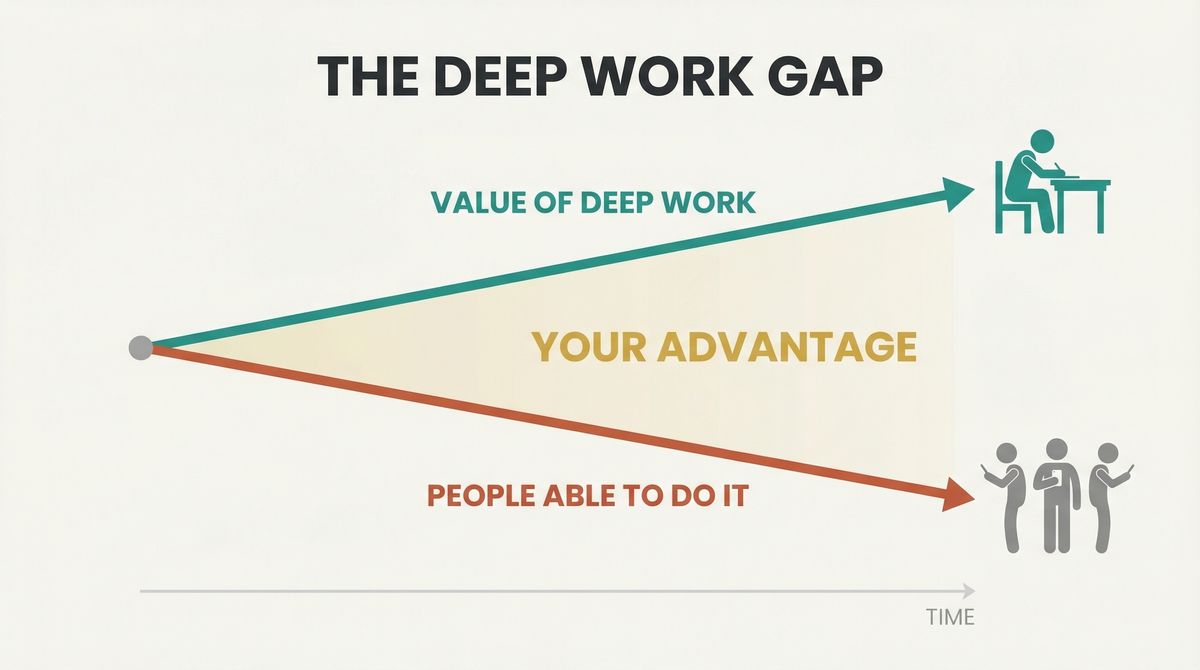
everyone knows that abstractly. It's his reframing of deep work as an economic arbitrage opportunity rather than a lifestyle preference. By positioning concentration as simultaneously scarce and valuable, he transforms what sounds like productivity advice into career strategy. The metric black hole concept is perhaps the book's most underappreciated insight: depth-destroying behaviors survive not because they're effective, but because their costs are invisible. This explains why entire industries adopt open offices and always-on messaging despite mounting evidence of damage — the same invisibility that protects executive salaries untethered from marginal productivity.
Where Newport is less convincing is in his treatment of collaboration. The hub-and-spoke model — separate serendipitous encounters from deep thinking — is elegant but underspecified for workers who can't choose their office architecture. His dismissal of the Jack Dorsey counterexample is also too tidy; the line between 'CEO who legitimately needs distraction' and 'manager who merely believes they do' is blurrier than he admits.
The book's lasting cultural influence comes from its vocabulary.
Terms like 'deep work,' ' shallow work,' and 'attention residue 'gave professionals a shared language for negotiating how they spend their time. Before Newport, requesting uninterrupted hours sounded like a productivity excuse; after Newport, it sounds like a strategic investment. The adapted 4DX framework — tracking deep work hours on a visible scoreboard — is deceptively powerful because it addresses the core behavioral problem: people optimize what they measure.
Published in 2016, Deep Work has aged remarkably well because the trends it diagnosed — notification creep, performative busyness, open-plan worship — have only accelerated. The rise of remote work, Slack, and AI tools since publication has widened the gap between those who can concentrate and those who cannot, making Newport's thesis more urgent than even he predicted.