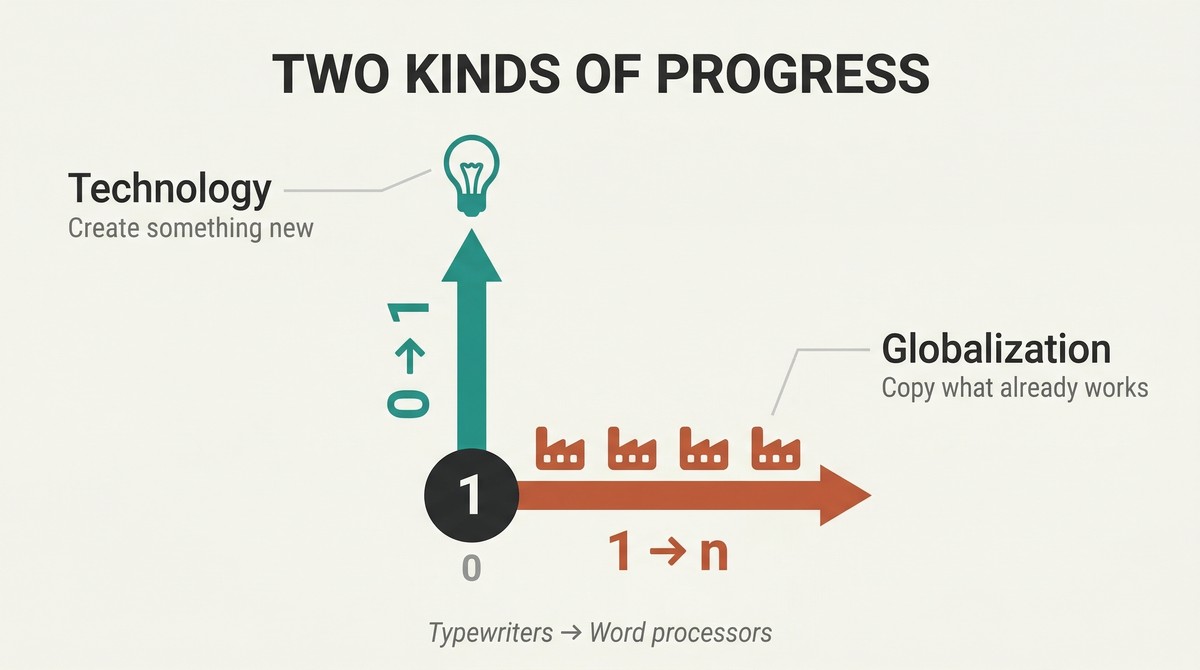
Zero to One is part manifesto, part anti-textbook.
It deliberately subverts conventional MBA wisdom at nearly every turn — monopoly over competition, planning over iteration, boldness over incrementalism. The book's intellectual DNA draws from Schumpeterian creative destruction (capitalism progresses through monopolies that displace incumbents), René Girard's mimetic theory (which informs Thiel's view of competition as unconscious imitation between similar rivals), and a strain of libertarian futurism that distrusts both bureaucratic regulation and crowd consensus.
What makes the book enduringly provocative is its willingness to state uncomfortable positions as simple truths. Thiel doesn't hedge when he calls competition destructive or declares capitalism and competition opposites. This rhetorical strategy — framing contrarian positions as overlooked common sense — is itself a masterclass in the hidden salesmanship the book describes.
The most underappreciated tension in Zero to One is between its determinism and its humility. Thiel argues forcefully for definite planning, yet acknowledges that 'no authority can prescribe in concrete terms how to be innovative.' The seven questions framework gives structure without guaranteeing outcomes. This is philosophically honest: the book offers lenses for thinking, not recipes for cooking.
The book's blindspots deserve mention.
Thiel's monopoly argument works elegantly for software companies with near-zero marginal costs but applies less neatly to industries with physical constraints. His survivorship bias is acute: we hear about PayPal's boldness but not the equally bold companies that crashed alongside Pets.com. The cleantech chapter, while brilliant as strategic analysis, may overstate how predictable those failures were in real time.
Still, Zero to One's lasting contribution is cultural more than tactical. It gave Silicon Valley an intellectual framework for ambition at a time when post-crash timidity had become orthodoxy. Its central provocation — that creating something genuinely new is both harder and more important than optimizing what exists — remains the most productive question any entrepreneur can sit with, even a decade after publication.