The Art of War endures not because it teaches how to fight, but because it teaches when not to.
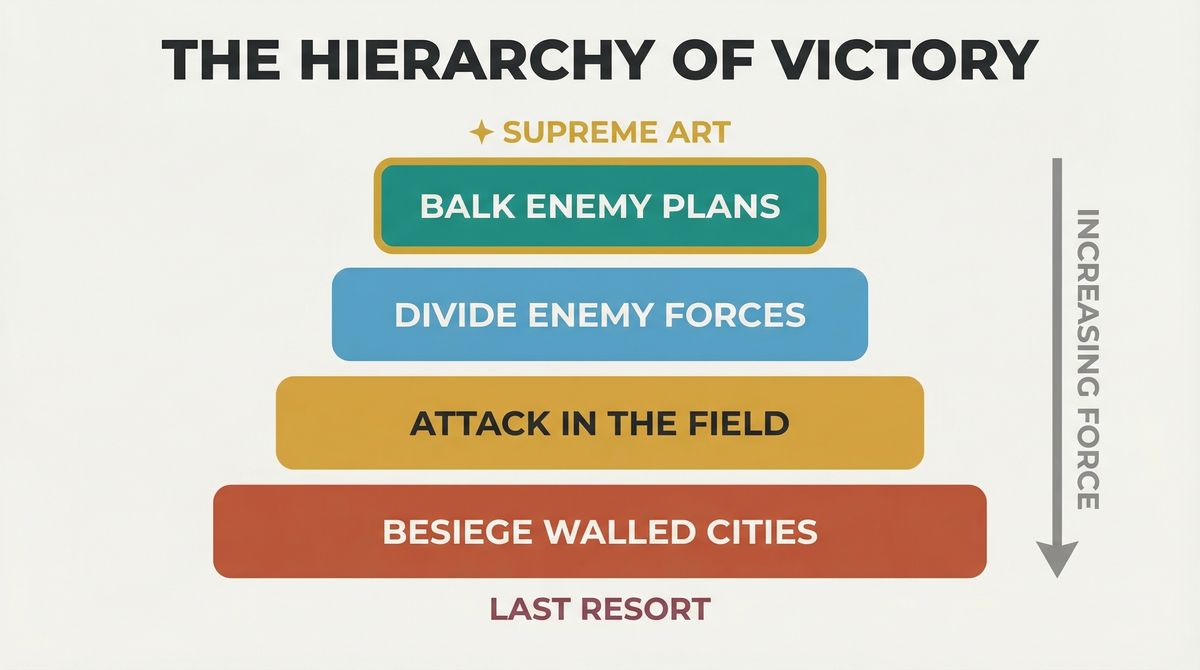
Written roughly 2,500 years ago and attributed to the semi-mythical Chinese general Sun Tzu, this slim treatise operates on a paradox that still startles: the supreme warrior is the one who never draws his sword. Its continued relevance across military academies, corporate boardrooms, and coaching staffs stems from a Taoist philosophical foundation that Western strategic thinkers largely missed. Where Clausewitz — the Prussian theorist who dominated European military thought — normalized war as 'politics by other means' and advocated pursuing it to absolute ends, Sun Tzu treated war as a catastrophic last resort whose aim was the swift restoration of normalcy. British military historian B.H. Liddell Hart argued in 1963 that civilization could have been 'spared much of the damage suffered in the world wars' had Clausewitz's influence been tempered by Sun Tzu's realism and moderation.
What makes the text remarkable is its fractal applicability.
The core principles — deception, intelligence, adaptability, restraint — scale cleanly from geopolitics to salary negotiations to parenting disputes. The water metaphor alone contains a complete strategic philosophy: be formless, find the path of least resistance, and when the moment arrives, be irresistible. This is not brute-force thinking; it is systems thinking rooted in ecological observation of how nature actually resolves conflict.
The Landmark Edition's pairing with the Tao Te Ching illuminates something routinely missed in popular readings: Sun Tzu's tactical genius is downstream of Lao Tzu's metaphysics. The insistence on softness overcoming hardness, on the power of emptiness, on the lethal danger of rigidity — these are not incidental themes. They are the operating system on which every specific tactic runs. Readers who absorb only the tactical surface without grasping the Taoist architecture beneath it will possess the letter of the teaching but miss its animating spirit — precisely the error Sun Tzu warns his generals against making.