Isaacson's biography operates on a central paradox that no amount of hagiography or criticism can resolve: Jobs's cruelty and his creativity were fed by the same neural wiring. The reality distortion field that enabled the iPhone also delayed cancer treatment. The controlling perfectionism that produced seamless devices also destroyed relationships. The book's genius is in refusing to untangle these threads and instead presenting them as a single braid.
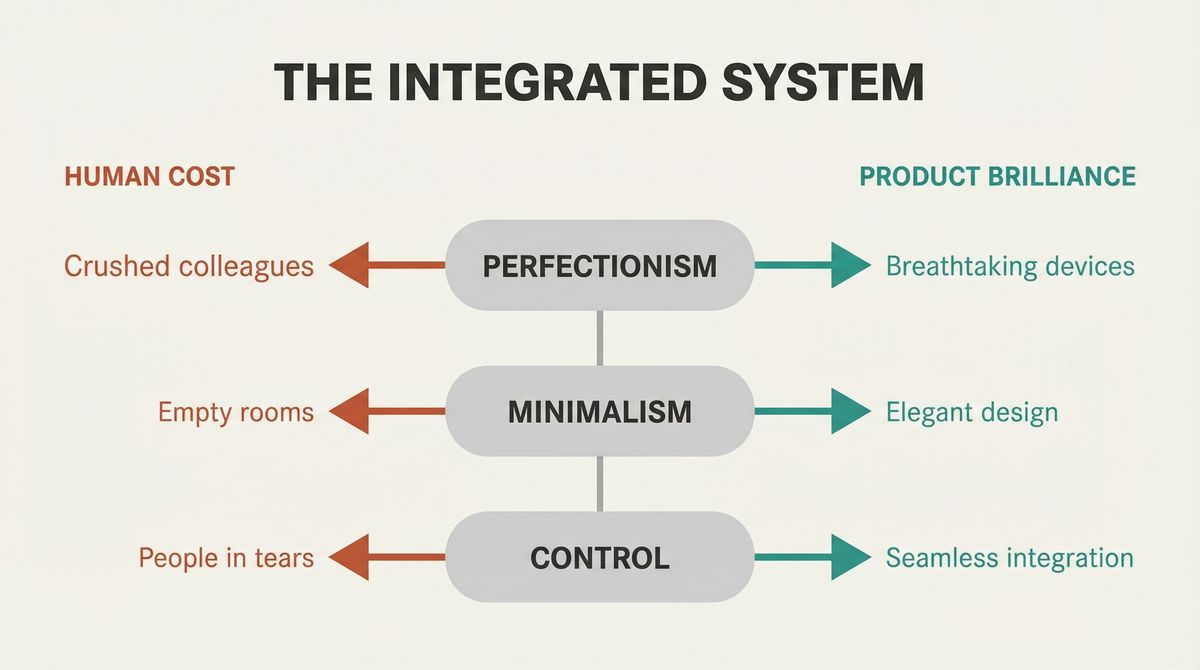
The most underappreciated insight is structural.
Jobs didn't just design products — he designed an organization incapable of the compromises that destroy great products. Apple had no divisional P&Ls, no consensus-driven product reviews, no tolerance for B-players in A-player meetings. This organizational architecture is harder to replicate than any specific product, which is why competitors who copied Apple's designs consistently failed to match its execution.
Isaacson's framing of the closed-versus-open debate deserves scrutiny. He presents it as a philosophical disagreement between Jobs and Gates, but the evidence suggests something more pragmatic: closed integration works spectacularly when you have a taste-making genius at the helm, and open systems work better when you don't. The question Isaacson leaves unresolved — whether Apple's integrated approach survives without its reality-distorting founder — is the most consequential business question of the post-Jobs era.
The biography has an important limitation
it was completed while Jobs was dying and cooperating fully. Isaacson was remarkably candid about Jobs's flaws, but the proximity to death inevitably shaped the narrative toward legacy-building. The sections on Jobs's abandoned daughter Lisa, his treatment of early Apple employees like Daniel Kottke, and his initial refusal of cancer treatment are presented with more sympathy than pure journalism might have afforded. Still, the result is the most complete portrait we will likely ever have of a figure whose influence on how humans interact with technology is rivaled only by the inventors of the printing press and the personal computer itself.