Manson's book is a Trojan horse
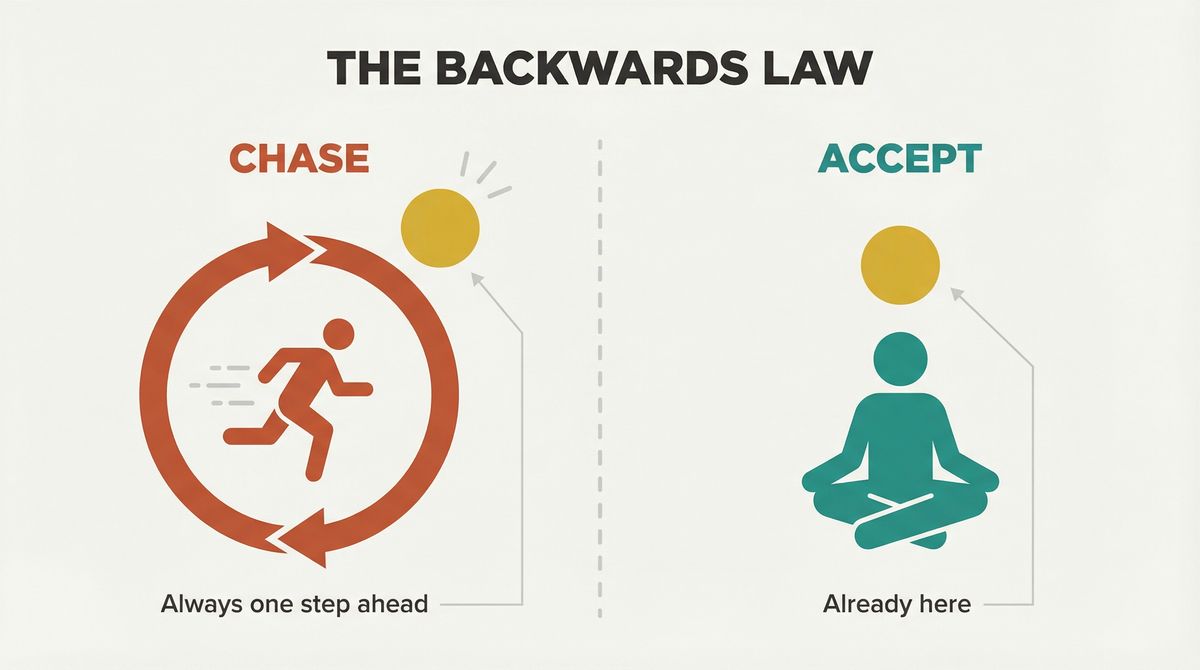
Stoic philosophy, existentialist thought, and Buddhist psychology packaged inside profanity-laced millennial-speak. The intellectual lineage is unmistakable — Alan Watts's backwards law, Camus's absurdism, Becker's terror management theory, and the shadow of Frankl's meaning-through-suffering thesis all appear, rebranded for readers who would never open The Denial of Death.
What elevates this above typical contrarian self-help is its values-first framework. Where most books in the genre tinker with surface behaviors — habits, routines, morning rituals — Manson works at the foundation: the metrics by which people judge their lives. The Mustaine-versus-Best comparison is the book's masterstroke. Two musicians with virtually identical origin stories (ejected from legendary bands on the threshold of fame) arrive at opposite emotional destinations purely because of different success metrics. It's a concrete, memorable proof of an abstract philosophical claim.
The book's structure mirrors its thesis, progressing from what to stop caring about (chapters 1 – 4) to what to start caring about (chapters 5 – 9), culminating in death as the ultimate value-clarifier. This arc lends more narrative cohesion than the modular, listicle-style format typical of the genre.
The work has genuine blind spots.
Manson's 'take responsibility for everything' principle borders on unfalsifiable — applied universally, it risks shading into victim-blaming, the very thing he claims to oppose. His treatment of the self-esteem movement oversimplifies decades of research that Baumeister himself later nuanced. The relentless irreverence occasionally substitutes for analytical depth, particularly in middle chapters where stories accumulate but the framework plateaus.
Yet the core architecture is sound: suffering is unavoidable; its quality depends on chosen values; and selecting those values consciously is the only meaningful freedom. The book functions as a gateway to serious existentialist philosophy for a generation raised on Instagram and participation trophies. Manson reaches readers who would never encounter Camus or Becker directly, delivering the essential insight — that a good life is not a painless one but a purposefully painful one — in language they'll actually absorb. The repackaging matters.