The Psychology of Money is an anthology of twenty loosely linked essays unified by a single thesis
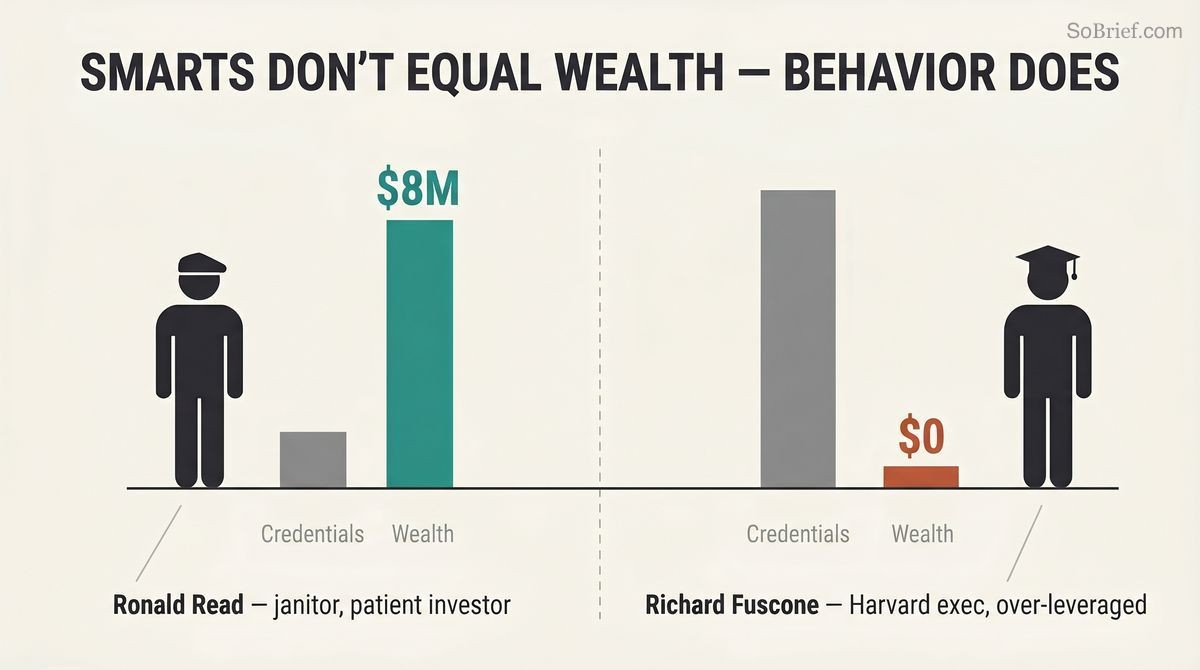
financial success depends far more on behavior, temperament, and emotional self-regulation than on intelligence, formulas, or market knowledge. Morgan Housel, a former columnist who began writing during the 2008 crisis, structures the book as a sequence of vivid parables (a janitor who outsaved a Harvard executive, Gates and his doomed friend, Livermore's rise and ruin) rather than a rigid framework, which makes it memorable but occasionally repetitive. The danger in summarizing it is that its power lives in the stories, not in abstractable principles; strip the anecdotes and you risk reducing rich insight to fortune-cookie maxims. The book sits at the intersection of behavioral economics and Stoic-adjacent life philosophy. Its intellectual lineage runs through Kahneman, Thaler, and Taleb, but Housel's contribution is translation: he renders academic findings into kitchen-table wisdom. His strongest, most original moves are the redefinitions, wealth as the spending you cannot see, savings as the gap between ego and income, volatility as a fee rather than a fine. These reframings perform genuine cognitive work, converting abstract concepts into actionable mental postures.
The book's limitations are worth naming.
It is largely silent on systemic constraints, structural inequality, discrimination, and the reality that for many people the savings gap is not a choice but an impossibility, though the closing postscript on the American consumer partially redeems this. The advice is also tilted toward people who already have surplus income to manage. Its survivorship bias is real: counsel patience and frugality and you will produce Ronald Reads, but also unlucky savers crushed by timing. Still, as a corrective to the math-obsessed, return-chasing default of personal finance culture, it is unusually humane, durable, and quietly radical in insisting that the goal of money is not more money but autonomy over one's own time.